
Agentic development workflow with Nora
Agentic development works best when it is treated as an operating workflow rather than a chat transcript. Nora is designed around that broader loop.
Move from prompt-centric execution to workflow-centric operation.
Combine tasks, specs, worktrees, and approvals in one workspace.
Keep changes reviewable as the system gets more parallel.
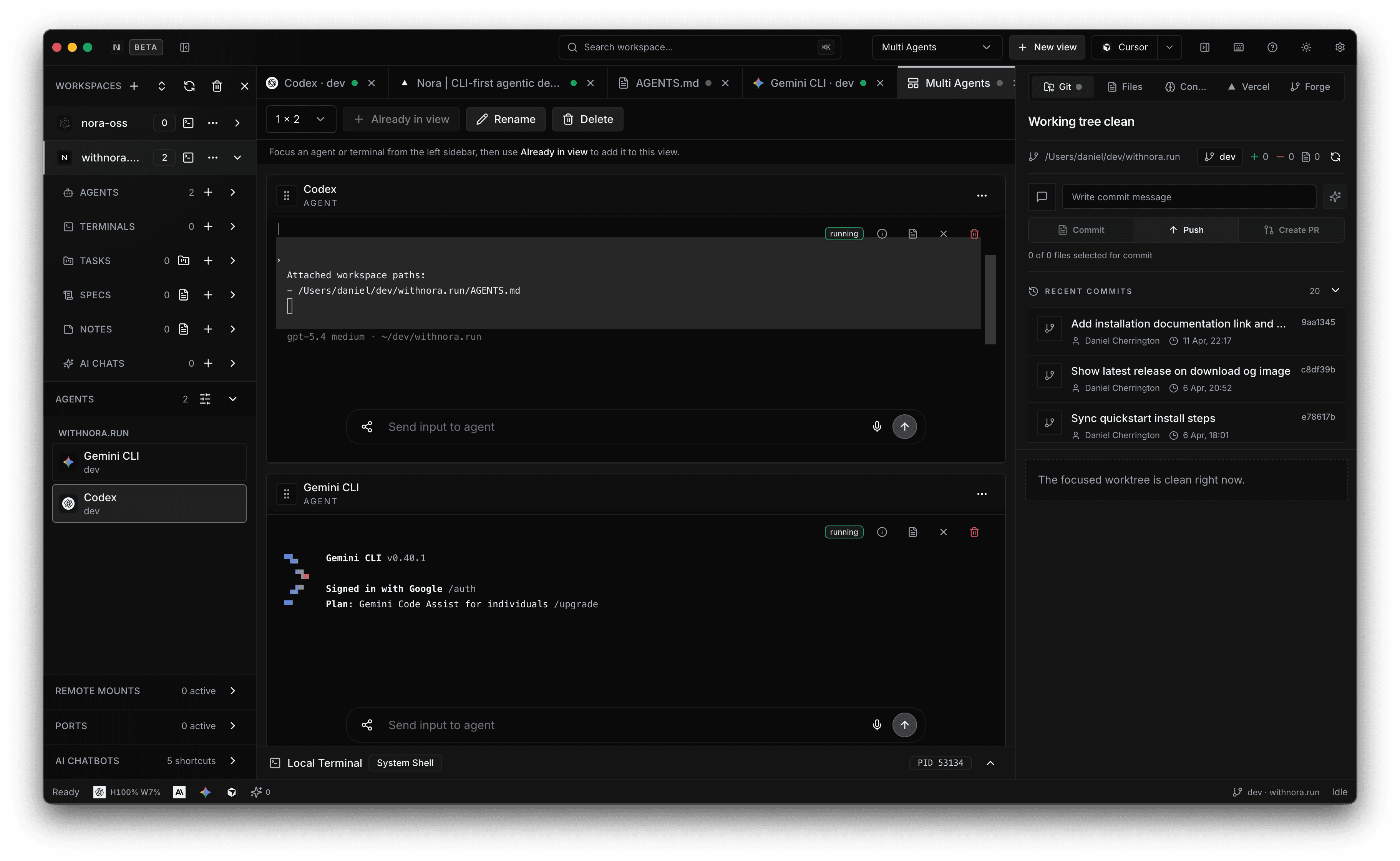
What an agentic workflow needs
A useful workflow needs more than a model connection. It needs repository context, tasks, specs, execution boundaries, human checkpoints, and a way to inspect what changed.
- Context should live near the work, not outside it.
- Execution boundaries matter once agents can write.
- Human checkpoints are part of the workflow, not an afterthought.
How Nora structures the loop
Nora ties together sessions, worktrees, tasks, approvals, and repository tools into one operator-facing workspace. That makes the workflow clearer than stitching together multiple separate tools.
- Sessions run against a real repository model.
- Tasks and specs keep goals explicit.
- Approvals and diffs keep output reviewable.
How to evaluate it
Start with the overview, quickstart, tasks, specs, approvals, and remote repo docs. That sequence shows how the product behaves as an operating environment rather than as a generic assistant wrapper.
- Overview gives the product frame.
- Quickstart proves the basic model quickly.
- Tasks, specs, and approvals show the operating loop.
What makes a workflow agentic rather than just AI-assisted?
An agentic workflow treats execution as part of a larger operating loop with tasks, repository state, approvals, and visible outputs rather than a one-off assistant reply.
Why does Nora focus on the workflow instead of just the agent?
Because the agent is only one part of shipping work. The operational structure around it determines whether the output stays understandable, reviewable, and scalable.