
Nora vs generic AI IDEs
Many AI IDEs are built around assisting the editing loop. Nora is built around operating agentic development as a workflow. That distinction matters once tasks become parallel, review-heavy, or repository-scale.
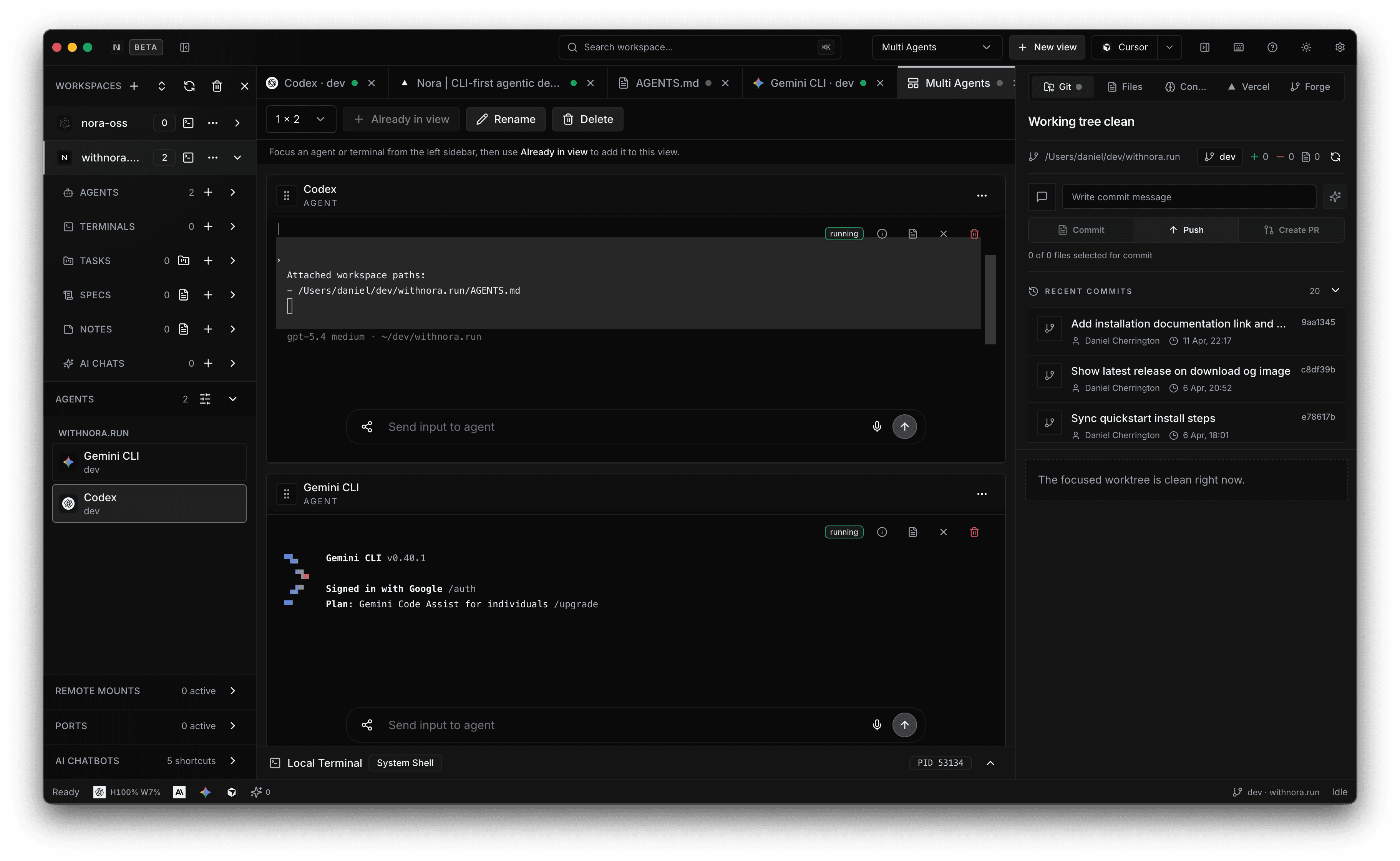
Most AI IDEs are editing tools first; Nora is an operator workspace first.
Nora is designed around sessions, worktrees, tasks, and approvals.
The right choice depends on whether your bottleneck is authoring code or coordinating agent work.
What generic AI IDEs optimize for
Generic AI IDEs usually optimize for code generation, inline assistance, refactoring help, and conversational support inside a coding editor. That makes them useful when the primary loop is still individual editing.
- Editor-first interaction model.
- High convenience for small or medium in-file tasks.
- Strong fit for developers who want AI embedded in normal editing.
What Nora optimizes for instead
Nora optimizes for operating a more explicit agent workflow: running sessions against real repositories, isolating work in worktrees, tracking diffs, and keeping review and approvals part of the product model.
- Repository-aware session structure.
- Built-in isolation for parallel work.
- A better fit for teams that treat agents as workflow participants, not just assistants.
How to think about the tradeoff
If your main need is better editing assistance, a generic AI IDE may be enough. If your main need is controlling, reviewing, and coordinating agent-driven development, Nora addresses a more specific operational layer.
- Choose an AI IDE for faster editing help.
- Choose Nora for clearer multi-step agent operations.
- Choose Nora when repository state and reviewability matter more than inline assistance.
Is Nora an IDE in the usual sense?
Not in the same way as a generic editor-centric AI IDE. Nora is better described as an agentic development workspace built around operation and review rather than traditional IDE ergonomics alone.
Who is Nora best suited for?
Nora is best suited for developers or teams whose workflows increasingly revolve around local coding agents, explicit task boundaries, worktree isolation, and human review.