
Local AI coding agents with Nora
Running coding agents locally matters when repository visibility, environment control, and human review are non-negotiable. Nora is built around that local-first model.
Operate agents directly against local repositories and files.
Keep environment and execution close to the operator.
Review changes in a visible workspace before they move forward.
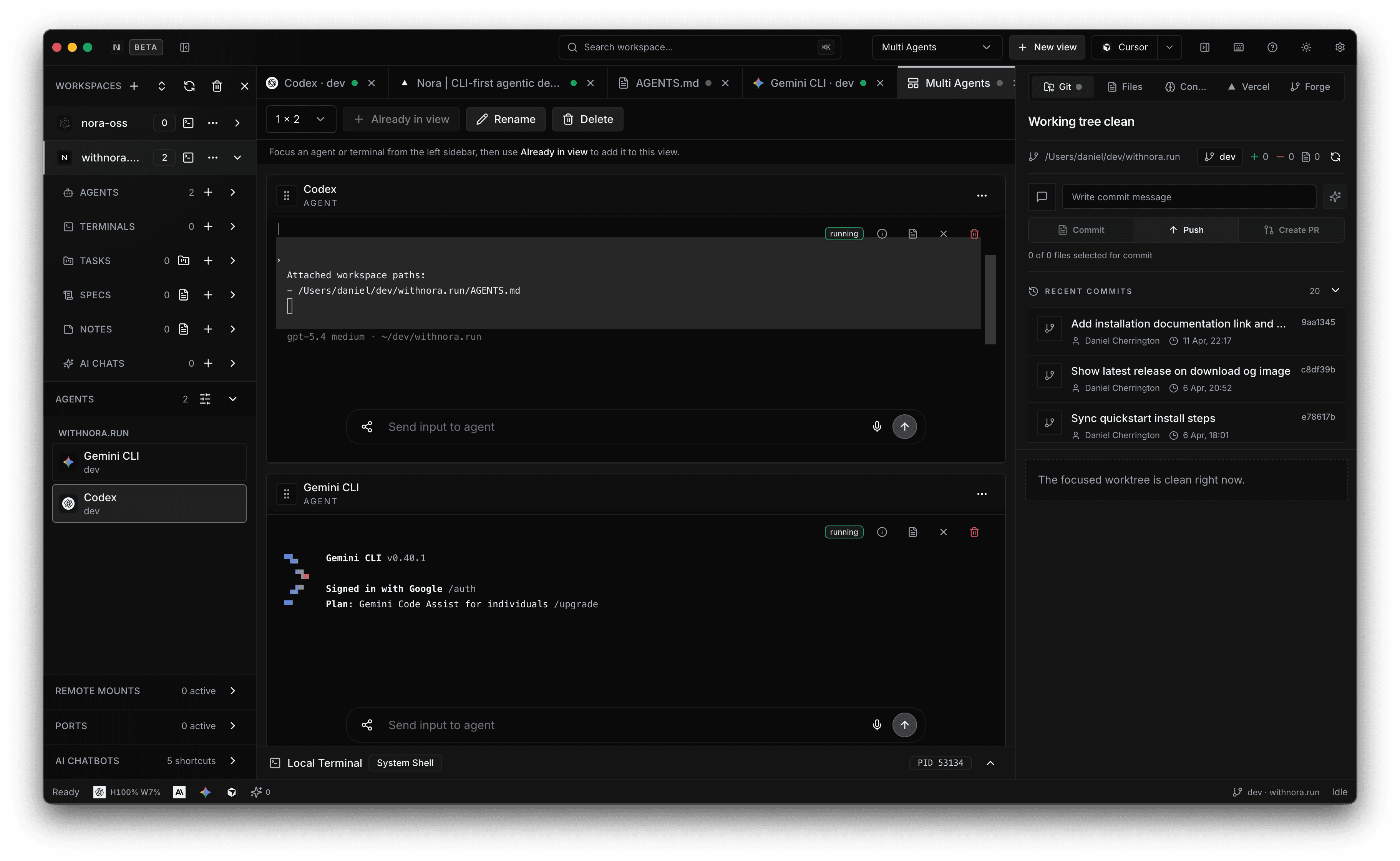
Why local execution matters
Local execution keeps the repository, files, and operational environment close to the operator. That is useful when you need tighter control over what an agent can see, edit, and run.
- Fewer hidden layers between the agent and the repository.
- A better fit for teams that want direct system visibility.
- Easier reasoning about what the agent is acting on.
Why a workspace still matters
Local execution alone is not enough. You still need a system for worktree isolation, task ownership, session state, diffs, and handoffs. Nora provides that structure instead of assuming the terminal session is the whole product.
- Local execution without workflow structure still gets messy.
- Worktrees, tasks, and diffs make local agent work legible.
- Handoffs become easier when the session context is explicit.
What to read next
The best follow-up docs are agents, worktrees, tasks, and approvals. Those pages explain how Nora keeps local agent work visible and controllable.
- Agents explains supported session models.
- Worktrees explains isolation.
- Approvals explains operator control.
Does local mean offline-only?
No. Local-first here means the workspace and execution model are anchored to your local repository and environment, even if some agent workflows also connect to remote services.
Why not just use a local terminal?
A terminal gives you execution, but Nora adds session structure, worktree management, diffs, and operator review around that execution.