
Nora vs running Claude Code in the terminal
Running Claude Code directly in the terminal is powerful and simple. Nora is what you add when that raw workflow starts to need more structure: isolated worktrees, session visibility, task boundaries, and cleaner operator review.
Terminal-first execution is flexible, but it does not automatically create workflow structure.
Nora adds repository and session visibility around Claude Code-style runs.
The gap becomes more obvious as tasks, diffs, and parallel work increase.
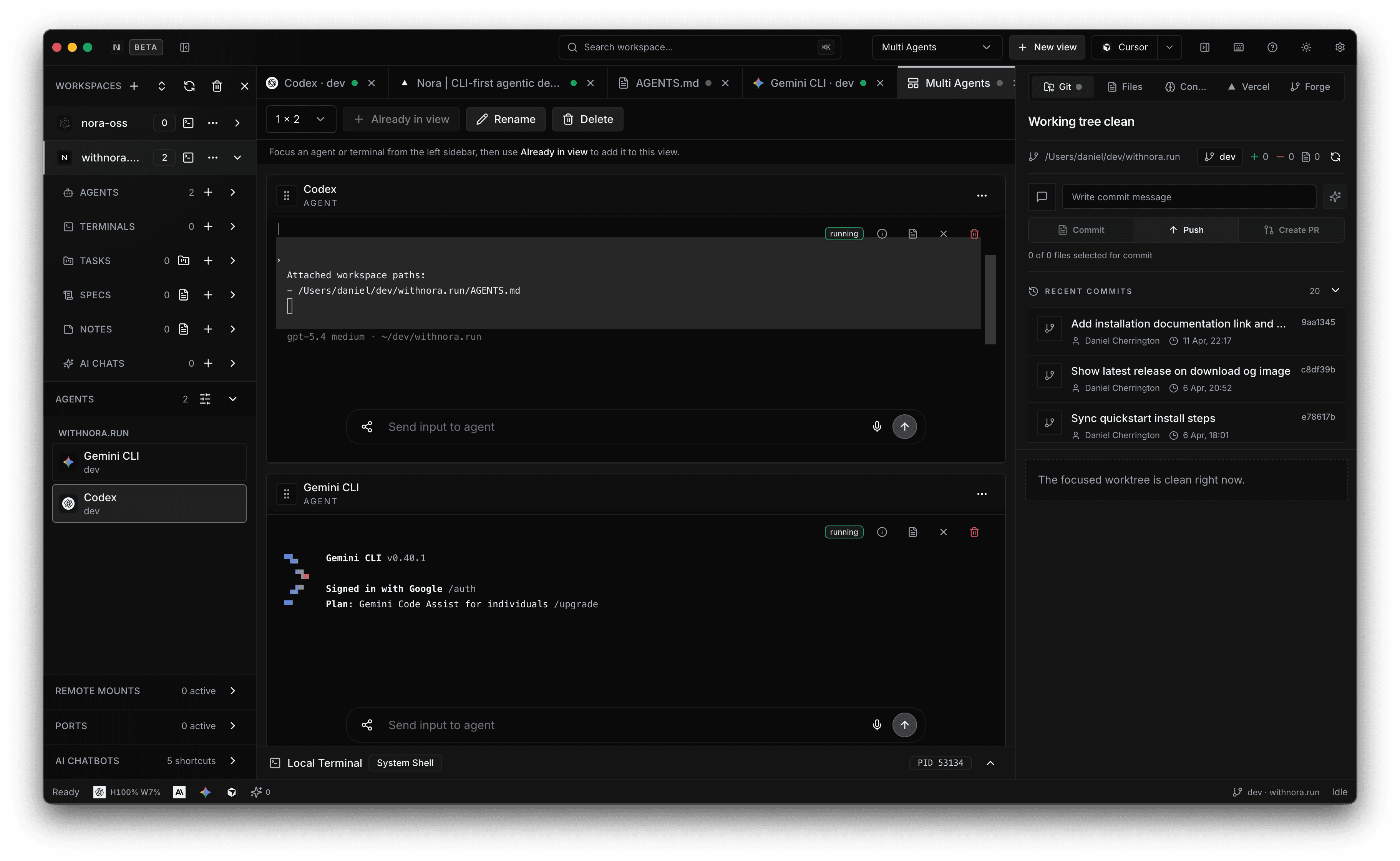
What the raw terminal workflow gets right
A raw Claude Code terminal workflow is direct, lightweight, and effective for short tasks. It keeps the toolchain simple and stays close to the repository and shell environment.
- Minimal setup and fast feedback loops.
- Direct control over the shell and repository.
- A good fit for individual experimentation and narrow tasks.
What starts to break down
As more sessions, tasks, and code changes accumulate, the raw terminal model gets harder to reason about. You still need to track what changed, where it ran, which branch it touched, and what should be reviewed next.
- Parallel work becomes harder to isolate cleanly.
- Branch and diff ownership can become ambiguous.
- Review steps are more manual and easier to miss.
Where Nora fits
Nora keeps the local-first execution model but adds the workspace layer around it. That includes worktrees, session structure, repository tooling, tasks, and a clearer human approval path.
- Preserves local execution while improving visibility.
- Makes session-to-diff attribution cleaner.
- Introduces a stronger operating model without turning the workflow into a black box.
Why not just stay in the terminal?
For many tasks you can. Nora becomes useful when you want the same local power but with more explicit structure around sessions, worktrees, diffs, and approvals.
Does Nora replace the underlying coding agent?
No. Nora is the workspace and operating layer around the agent execution model, not the replacement for the agent itself.